Food Safety and Kitchen Hygiene for Families With Young
Foodborne illness affects millions of children worldwide each year. Learn how to practise food safety in the family kitchen, teach young children hygiene habits, and protect your family from the most common food safety risks.

Food Safety and Kitchen Hygiene for Families With Young
“Foodborne illness affects millions of children worldwide each year. Learn how to practise food safety in the family kitchen, teach young children hygiene habits, and protect your family from the most common food safety risks.”
Why Food Safety Matters Especially for Young Children
Foodborne illness is among the most preventable causes of acute illness in young children globally, yet it remains extraordinarily common. The World Health Organisation estimates that approximately 600 million people suffer from foodborne illness each year worldwide, and children under the age of five are disproportionately affected, accounting for 40 percent of the global burden of foodborne disease despite representing only 9 percent of the global population. Children aged 4 to 7 are at elevated risk due to their immune systems being still in development, their lower body weight relative to adults (which means a smaller dose of a pathogen causes greater relative harm), and their developing but not yet robust hygiene habits.
The consequences of foodborne illness in young children range from unpleasant but manageable gastroenteritis to serious complications including dehydration requiring hospitalisation, kidney failure in the case of certain E. coli strains, and in rare cases death. Many parents are surprised to learn that a significant proportion of foodborne illness cases in young children occur not from restaurant meals or purchased food products but from food prepared and stored at home.
Understanding the main causes of foodborne illness, how to prevent them through correct food handling and storage, and how to teach children in this age group the hygiene habits that support food safety is a direct contribution to child health and wellbeing.
The Main Causes of Foodborne Illness in Families
Foodborne illness is caused by bacteria, viruses, and parasites present in food that has been contaminated, stored incorrectly, or insufficiently cooked. Understanding the main culprits helps families prioritise their food safety efforts effectively.
Salmonella bacteria are among the most commonly reported causes of foodborne illness globally. They are found in raw poultry, eggs, meat, and occasionally in fresh produce that has been contaminated. Salmonella is destroyed by thorough cooking, which is why undercooked chicken and runny eggs carry greater risk than fully cooked equivalents. Symptoms typically develop within 12 to 72 hours of exposure and include fever, diarrhoea, abdominal cramps, and vomiting.
Campylobacter is the most commonly reported bacterial cause of foodborne illness in many high-income countries. It is primarily associated with raw and undercooked poultry and with unpasteurised milk. It can also be spread through cross-contamination when raw poultry juices come into contact with other food, surfaces, or hands. Campylobacter infection is unpleasant and in rare cases can lead to serious complications including reactive arthritis and Guillain-Barre syndrome.
E. coli, particularly strain O157:H7 and related strains, can cause severe illness especially in young children. It is found in undercooked minced meat, unpasteurised dairy products, and contaminated fresh produce. Certain E. coli strains produce toxins that can cause haemolytic uraemic syndrome, a serious complication that can lead to kidney failure. This risk is one reason why children under 5 are generally advised to have minced meat cooked thoroughly rather than eaten rare or pink.
Norovirus is the most common cause of gastroenteritis globally and spreads easily through contaminated food, water, and surfaces, as well as through direct contact with infected individuals. It is highly contagious and can spread rapidly within households. Thorough handwashing, particularly after using the toilet and before preparing food, is the most effective prevention measure.
Handwashing: The Foundation of Food Safety
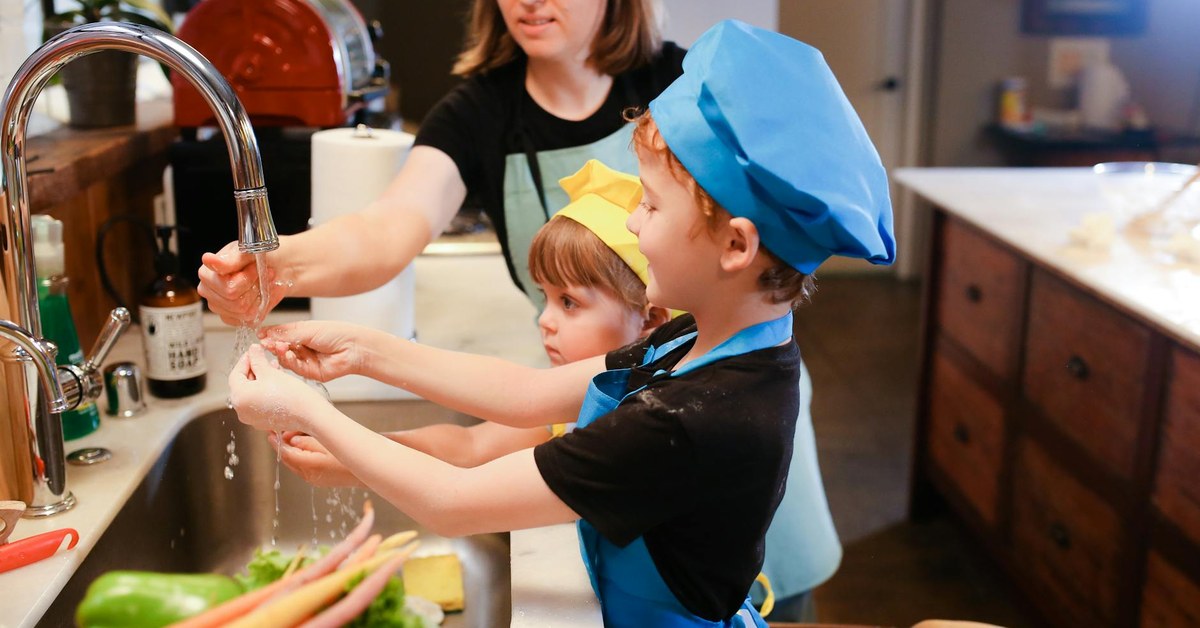
Proper handwashing is the single most effective food safety intervention available and is within the capability of children as young as 4 to learn and practise consistently when taught correctly. Pathogens that cause foodborne illness are transmitted via the hands from surfaces, animals, toilet use, and direct contact with contaminated materials to food and to mouths.
Effective handwashing requires soap and water and takes approximately 20 seconds of active scrubbing. Simply wetting hands does not remove pathogens effectively. Teach children to wet their hands, apply soap, rub all surfaces of both hands including between fingers, under nails, and the backs of hands, for at least 20 seconds (roughly the time to sing the happy birthday song twice), then rinse thoroughly and dry on a clean towel.
The moments when handwashing is most important in the context of food safety include before eating, before helping with food preparation, after touching raw meat or poultry, after handling pets or animals, after using the toilet, after blowing the nose or coughing into hands, and after touching bin lids or waste. Establishing these as automatic triggers for handwashing in children requires consistent modelling and gentle reinforcement over time, but the habits established in the early years tend to persist.
Hand sanitiser is a useful supplement to handwashing when soap and water are not available but is not a substitute for it in contexts involving food preparation and eating. Sanitisers are less effective against norovirus, and heavily soiled hands require soap and water to remove contamination before sanitiser can be effective.
Safe Food Storage at Home
Incorrect food storage creates conditions in which bacteria multiply rapidly, turning safe food into a health hazard. Understanding and applying basic food storage principles reduces the risk of foodborne illness from home-prepared food significantly.
The refrigerator should be maintained at 5 degrees Celsius or below. Many refrigerators in homes are set too warm, allowing bacterial growth to occur more quickly. A refrigerator thermometer is a simple and inexpensive tool that allows you to verify the actual temperature rather than relying on the dial setting, which may not correspond accurately to the true temperature.
Raw meat, poultry, and fish should be stored on the lowest shelf of the refrigerator in sealed containers to prevent juices from dripping onto other foods below. Raw and cooked foods should never be stored together without a barrier. Use separate containers and keep cooked and ready-to-eat foods above raw items.
Leftovers should be cooled quickly and refrigerated within two hours of cooking. Food left at room temperature for longer than two hours enters the temperature danger zone in which bacteria multiply rapidly. Do not leave hot food out to cool for extended periods before refrigerating; large amounts can be divided into smaller containers to speed cooling.
Use leftovers within two to three days of preparation and reheat them thoroughly to a core temperature of 70 degrees Celsius or above before serving. Do not reheat the same food more than once. When in doubt, throw it out, as the appearance and smell of food cannot reliably indicate whether it is safe to eat.
Cross-Contamination: Understanding and Preventing It
Cross-contamination is the transfer of harmful bacteria from one food or surface to another, and it is responsible for a significant proportion of food-related illness in homes. Many families are unaware of how easily cross-contamination occurs in a domestic kitchen.
Use separate chopping boards for raw meat and poultry and for ready-to-eat foods such as vegetables, bread, and fruit. Colour-coded boards make this easier to maintain consistently. Wash boards thoroughly with hot soapy water after each use with raw meat or poultry, or use a dishwasher which provides more thorough sanitisation than hand washing.
Wash knives, utensils, and any surface that has been in contact with raw meat, poultry, or fish before using them for other foods. This includes tongs, spatulas, and plates that raw food has rested on. In barbecue settings, a common error is using the same tongs or plate that held raw meat to serve the cooked food, transferring raw juices directly onto the cooked product.
Kitchen cloths and sponges are among the most bacteria-laden items in many home kitchens. Replace dishcloths regularly, wash them at high temperature, and consider using disposable paper towels for wiping surfaces that have been in contact with raw meat. A wet cloth used to wipe down multiple surfaces can spread contamination widely rather than removing it.
Safe Cooking Temperatures for Families
Sufficient cooking heat kills the pathogens that cause foodborne illness. Knowing the core temperatures that ensure food safety and using a food thermometer to verify them removes the guesswork from cooking safety.
Whole cuts of beef, pork, and lamb should reach a core temperature of at least 63 degrees Celsius with a rest time. Minced meat and burgers require a higher temperature of 71 degrees Celsius throughout, as the grinding process distributes surface bacteria throughout the meat. Poultry, whether whole or in pieces, should reach 74 degrees Celsius throughout. Fish should be cooked until opaque and flake easily, reaching 63 degrees Celsius.
For children aged 4 to 7, food should generally be served fully cooked. Rare and medium-rare meats, raw shellfish, and runny eggs carry risk that is acceptable for healthy adults but is more significant for young children whose immune responses to foodborne pathogens are less robust. This guidance is particularly important for children with any health condition affecting immune function.
Teaching Kitchen Hygiene to Children Aged 4-7
Children in this age group are at a stage where they can begin to participate meaningfully in kitchen activities including simple food preparation. This is a valuable opportunity to embed hygiene habits through practice rather than instruction alone.
Make handwashing the automatic first step of any cooking activity. Before touching any food, before helping to stir, before tasting, hands are washed. This habit, established consistently from early kitchen involvement, becomes automatic and carries forward into the child's independent food preparation as they grow older.
Explain the reasons behind food safety rules in simple, honest terms without creating fear. Food safety language for young children might include: we always wash our hands before we cook because there are tiny things we cannot see on our hands that can make us feel very poorly in our tummies. This is more effective than abstract rules and gives children the conceptual framework to apply hygiene reasoning to new situations.
Involve children in age-appropriate kitchen tasks that are both safe and engaging. Washing vegetables, tearing salad leaves, stirring cold ingredients, counting and measuring, and setting the table are activities that build kitchen confidence while reinforcing the hygiene routines that surround food preparation. Close adult supervision should always be maintained when children are in the kitchen, both for safety from heat and sharp implements and for guidance on hygiene practice.
Choking Risks and Food Safety for This Age Group
Food safety for children aged 4 to 7 includes not only the microbiological risks of contamination but also the physical risk of choking. Children in this age group are still at elevated risk of choking compared with older children and adults, as their swallowing coordination is still developing and they are more likely to eat quickly, talk while eating, or be distracted during meals.
Foods that pose a higher choking risk for children in this age group include whole grapes, whole cherry tomatoes, large chunks of raw carrot, whole nuts, hard sweets, large pieces of meat, popcorn, and any food with a skin that may separate during chewing. Where possible, modify the presentation of these foods: grapes and cherry tomatoes should be cut lengthways, carrots can be grated or cooked until soft, and large pieces of meat should be cut into small pieces appropriate to the child's mouth size.
Establish a no-running-or-rushing-while-eating rule and ensure meals take place in a calm, seated environment where children can focus on eating without distraction. A child who is eating while playing, watching television, or rushing to finish is at greater choking risk than one who is seated and focused. Adult supervision during mealtimes allows rapid response if a choking incident does occur.