Trampoline Safety for Young Children

Trampoline Safety for Young Children
Introduction: A Popular Activity with Serious Risks
Trampolines are a fixture in back gardens, playgrounds, and indoor play centres across much of the world. For young children, the appeal is obvious: bouncing is exhilarating, physically engaging, and deeply enjoyable. However, trampolines are also one of the most significant sources of childhood injury globally, responsible for hundreds of thousands of emergency department visits each year.
Understanding the specific risks associated with trampolines, and the evidence-based rules that substantially reduce those risks, is essential for any parent, carer, or childcare professional supervising young children. This article provides comprehensive guidance drawing on paediatric health organisations, injury prevention research, and international data.
The Scale of the Problem: Global Injury Statistics
The statistics on trampoline injuries are consistent across countries with good injury surveillance data. In the United States, the American Academy of Orthopaedic Surgeons reports that trampolines cause approximately 100,000 injuries requiring emergency department treatment each year. In the United Kingdom, the NHS and the Royal Society for the Prevention of Accidents (RoSPA) have documented similarly high rates proportional to population.
In Australia, research published in the Medical Journal of Australia identified trampolines as a leading cause of childhood fractures, with children under six years of age at disproportionately high risk of serious injury relative to their size. A study published in the journal Injury Prevention found that the introduction of the garden trampoline as a mass-market product in the 1990s was directly correlated with a statistically significant increase in paediatric forearm fractures across multiple countries.
The injuries sustained on trampolines range from minor bruising and sprains to fractures, dislocations, spinal injuries, and head trauma. Cervical spine injuries, while less common, are among the most catastrophic outcomes and can result in permanent disability. The head, neck, upper limbs, and lower limbs are the most commonly affected body areas, in varying proportions depending on the specific injury mechanism.
Why Multiple Bouncers Is the Greatest Risk Factor
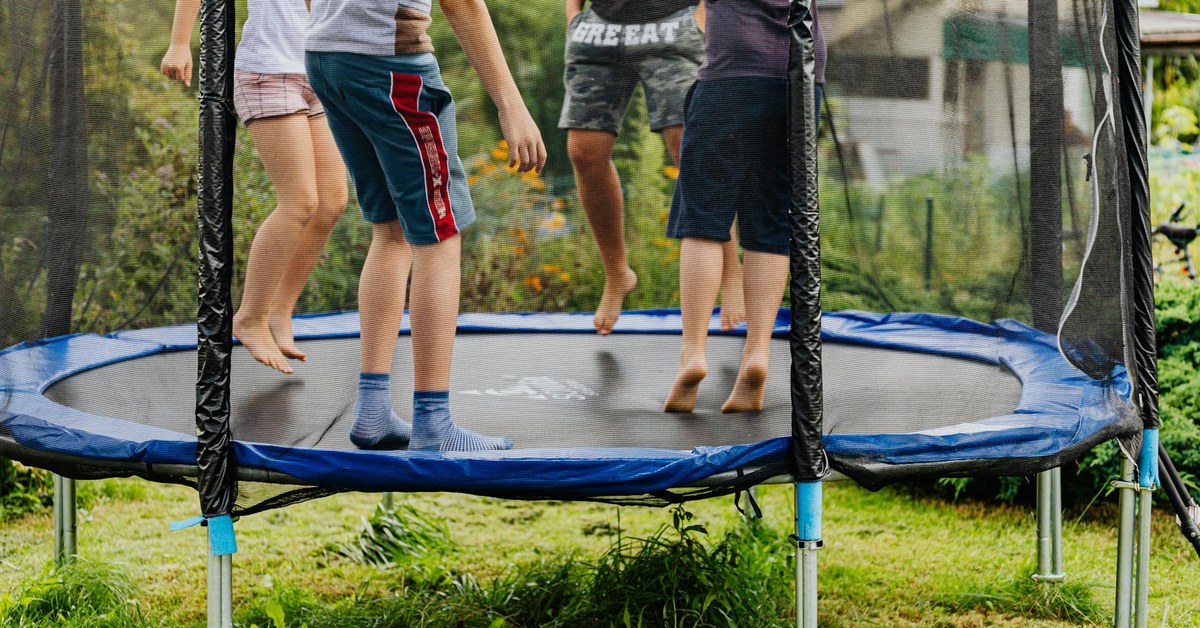
The single most consistent finding across trampoline injury research is that the presence of more than one person on a trampoline at the same time dramatically increases injury risk. Studies from multiple countries have found that between 75% and 85% of trampoline injuries occur when more than one person is bouncing simultaneously.
The physics of this are straightforward. When two people are on a trampoline simultaneously, the energy from one person's bounce is transferred to the other, causing unpredictable and uncontrollable forces. A smaller or lighter person, such as a young child, who is bouncing at the same time as a larger person is at extreme risk of being projected with far greater force than the child's own bouncing would produce. This "double bounce" effect can throw a child to a height that leads to serious landing injuries, or can project them off the trampoline entirely.
The one-at-a-time rule is endorsed without exception by the American Academy of Pediatrics (AAP), the British Orthopaedic Association, the Royal Children's Hospital Melbourne, and virtually every paediatric and orthopaedic health body that has published guidance on trampolines. It is not a suggestion; it is the primary safety rule for trampoline use by children.
Age and Weight Guidelines
Most major paediatric health organisations recommend that children under six years of age should not use full-sized trampolines. This recommendation is based on the developmental vulnerability of young children's musculoskeletal systems, their limited capacity to control their movements and landing positions, and their inability to reliably follow safety rules.
Children's bones in early childhood contain significant cartilage, particularly at the growth plates near the ends of long bones. These areas are particularly susceptible to injury and, if damaged, can affect subsequent bone growth. The forces generated even during normal trampoline use can stress these growth plate areas significantly in very young children.
Trampoline manufacturers typically specify minimum age and weight requirements for their products. These specifications should be observed strictly and are not conservative estimates; they are based on the engineering of the equipment. Overloading a trampoline with a weight exceeding its design capacity increases the risk of frame failure, spring detachment, and mat damage.
Enclosure Nets and Their Limitations
The introduction of enclosure nets as a standard component of domestic trampolines represented a genuine advance in safety, and research has confirmed that enclosures reduce the incidence of fall-from-trampoline injuries. However, several important limitations must be understood by parents and carers.
- Enclosures do not prevent the most common injuries. The majority of trampoline injuries occur on the trampoline surface itself, not from falls to the ground. Landing injuries, spring and frame contact injuries, and multiple-bouncer collision injuries all occur within the enclosure.
- Enclosures can fail. Net poles can buckle, zips can break, and nets can tear. Regular inspection of the entire trampoline, including the enclosure net and poles, the mat, all springs, and the frame padding, should be carried out before every use.
- Enclosures do not replace supervision. A child within an enclosed trampoline is not safe without adult supervision. Injuries occur quickly and without warning; an adult must be watching at all times.
- Frame padding must cover all springs. Contact with metal springs is a common cause of lacerations and pinching injuries. Frame padding degrades over time and may need replacement; worn or displaced padding should be replaced before the trampoline is used again.
Adult Supervision Requirements
Active adult supervision is required for all trampoline use by young children. This means a responsible adult should be present at the trampoline, observing the child throughout their bouncing session. It is not sufficient for an adult to be inside the house or in the garden but engaged in another activity.
Supervision responsibilities include:
- Enforcing the one-at-a-time rule consistently and without exceptions
- Ensuring the child is using the trampoline within their ability level
- Watching for signs of fatigue, which increases injury risk
- Monitoring the condition of the equipment during use
- Ensuring the ladder, if present, is removed or secured when the trampoline is not in active use, to prevent unsupervised access
Older siblings, even teenagers, should not be assigned supervisory responsibility for young children on trampolines. The demands of attentive supervision, combined with the social pressure that often leads teenagers to permit rule-bending, make this an unreliable safeguard.
No Somersaults or Advanced Moves for Young Children
Somersaults and flips are associated with a disproportionate number of serious trampoline injuries, including the catastrophic cervical spine injuries mentioned earlier. A somersault that is mistimed or performed with slightly incorrect technique can result in landing on the head or neck rather than the feet or back, with potentially devastating consequences.
Young children, whose motor control and spatial awareness are still developing, should not attempt somersaults, flips, or any other rotational moves on a trampoline. The prohibition on these moves should be absolute for children in the four to seven age range, regardless of perceived ability or confidence.
Even for older children and adults, somersaults should only be practised in a supervised coaching environment with appropriate crash mats and professional guidance. The domestic garden trampoline is not an appropriate setting for learning aerial skills.
Other moves that should be avoided by young children include:
- Seat drops combined with high bouncing
- Back drops
- Jumping onto or off the trampoline whilst in motion
- Attempting to bounce off the enclosure net
Safe Landing Positions and Basic Technique
Teaching young children a few fundamental principles of safe bouncing reduces injury risk significantly:
- Land with knees slightly bent to absorb impact rather than with straight, locked legs, which transmits force directly to the joints and spine.
- Keep arms out to the sides when bouncing to assist balance rather than reaching forward or backward.
- Bounce in the centre of the mat. The outer areas of the mat, near the springs and frame, are more dangerous landing zones. Children should be taught to maintain central positioning.
- Stop bouncing before getting off. Children should come to a controlled stop before attempting to exit the trampoline. Jumping from a moving trampoline to the ground is a frequent cause of ankle and wrist injuries.
- Do not bounce when tired. Fatigue impairs coordination and increases injury risk. Trampoline sessions for young children should be kept short.
First Aid for Trampoline Injuries
Despite all precautions, injuries on trampolines do occur. Parents and carers should be familiar with basic first aid responses for the most common trampoline injuries.
Sprains and Soft Tissue Injuries
Minor sprains and bruises are the most common trampoline injuries. The RICE protocol (Rest, Ice, Compression, Elevation) is the standard initial management for most soft tissue injuries. Ice should not be applied directly to skin; use a cloth or towel as a barrier. If swelling is significant or pain does not improve within 24 to 48 hours, seek medical assessment to rule out fracture.
Suspected Fractures
If a child is unable to weight-bear, has significant swelling, tenderness, or visible deformity at a limb, a fracture should be suspected. Immobilise the affected limb in the position found, apply ice as above, and seek prompt medical assessment. Do not attempt to straighten a suspected fracture.
Head and Neck Injuries
Any injury involving the head or neck requires careful assessment. If a child is unconscious, even briefly, vomits after a head impact, develops a severe headache, becomes confused or unusually drowsy, or complains of neck pain following an impact, seek emergency medical care immediately. A child who complains of tingling, numbness, or weakness in any limb after a fall should not be moved and emergency services should be called; these symptoms may indicate a spinal injury.
Paediatric Guidance from Major Health Bodies
The following recommendations reflect the consensus of major paediatric health organisations internationally:
- The American Academy of Pediatrics advises that trampolines should not be used recreationally and specifically states that trampolines should not be used at home, on playgrounds, or in physical education classes.
- The Canadian Paediatric Society similarly recommends against recreational trampoline use by children.
- RoSPA (UK) advises strict supervision, one user at a time, and no somersaults for children.
- The Royal Children's Hospital Melbourne recommends against children under six using trampolines and endorses strict supervision and single-user rules for older children.
These recommendations reflect a careful weighing of evidence and are not made lightly. For families who choose to have a trampoline, strict adherence to all safety guidelines is the minimum standard of responsible care.
Summary
Trampolines are a genuine source of enjoyment for many children, but they are also a significant and well-documented cause of childhood injury across the world. The rules that most effectively prevent injury are clear and consistent across all paediatric guidance: no children under six, one user at a time without exception, active adult supervision throughout, no somersaults or advanced moves, regular equipment inspection, and teaching safe landing technique. By understanding and consistently enforcing these rules, families can substantially reduce the risk of serious injury while still allowing children to enjoy physical play.